
|
|
|
|
2003
|
|
FSR-O OFFSHORE
|
| Issued by the FSR Section of Naviga |
| in February 2003 |
|
World Organisation for Model shipbuilding and Model ship sport Weltorganisation f�┴ Schiffsmodellbau und Schiffsmodellsport Organisation Mondaile de Navimodelisme et de Sport Nautique |
|
NAVIGA - Competition Rules 2003 Categories FSR - O |
|
The NAVIGA - Competition rules of 2003 for the categories FSR-O have been
updated based on the NAVIGA - 2000 Competition Rules, and the decisions during the General meeting in 2002
Amendments, additions and proposals for improvements are to be directed to the NAVIGA Section Management via the representative of the country. This version is copied from the FSR-H and FSR-V rulebook. The paragraphs that are valid from that book are blanked in this version. Just to get it easier to copy this version into that book when this is ready. |
| The NAVIGA Executive Committee |
|
CONTENTS:
|
|
3.1.1. Competitions where the rules apply 3.1.2. Entry fees 3.1.3. Protest fees 3.2.1. Age Groups 3.2.2. Competitors registration 3.2.3. Maximum allowed number of competitors 3.2.4. Assistant and substitution of the competitor 3.3.1 Propulsion of models and propulsion agents (fuel) 3.3.2 Fuels 3.3.3 Noise reduction, noise level measurement and rules 3.3.4 Application and use of radio control equipment and frequency control 3.3.5 Time measuring 3.3.6 Buoys (dimensions, construction, anchorage) 3.3.7 Starting pontoon (construction and materials) 3.4.1. The competition area 3.4.2. Starting area, preparation area and access permission 3.4.3. Allowed number, entries and condition of models 3.4.4. Re-run of a race 3.4.5. Registration numbers 3.4.6. Registration of competitors and models 3.4.7. Issuing of starting permits, issuing start and computer passes 3.4.8. Surrender of competitor passes and assessment of running order 3.4.9. Calling time (time allowed to get ready) 3.4.10. Preparation times (at the starting point) 3.4.11. Interruption / Suspension of the competition 3.4.12. Scoring and announcement of the results 3.4.13. Checking of the first three placed models during World and Continental Championships 3.4.14. Awarding of titles at World and Continental Championships 3.4.15. Award ceremonies at World and Continental Championships 3.4.16. Result lists 3.5.1 Principal rules 3.5.2 Lodging of protests 3.5.3 Handling of protests
6.2 Manning level of the start pontoon 6.3 Minimum requirements for the starting area 6.4 Competition course and race duration in FSR-V classes 6.5 Procedure for races in the FSR-V classes 6.6 Lap counting for FSR-V races 6.6.1 Manual lap counting 6.6.2 Computerised lap counting 6.7 Scoring in FSR-V classes 6.8 Composition of result lists in the FSR-V classes 6.9 Competition course and race duration in the FSR-H classes 6.10 Start clock for FSR-H classes 6.11 Procedure for races in the FSR- H classes 6.12 Basic rules and penalties in the FSR - H classes 6.12.1 Left turns 6.12.2 Right of way 6.12.3 Negotiating / passing the buoys 6.13 Rules for overtaking in the FSR-H classes 6.14 Calculation of final results in FSR-H classes 6.15 Composition of result lists in the FSR-H classes 6.16 Competition course and duration of a race in the FSR-O classes 6.17 Procedures for races in the FSR-O classes 6.18 Lap Counting for FSR-O races 6.18.1 Manual lap counting 6.18.2 Computerlised lap counting 6.19 Scoring in FSR-O classes 6.20 Composition of Result Lists in the FSR-O classes 7.1 General 7.2 Measuring methods in FSR-H 7.3 Measuring methods in FSR-V
|

|
Competition rules for radio controlled models in categories FSR – H and FSR-V
|
1. Definition of models Models in the FSR categories are controlled by the competitor using radio control. These are model boats of free design, which conform to the race requirements,however should in form and design look like a boat. Offshore boats are deep vee or tunnel hull with surface or semi-surface drive. Hydro-plane other three or more planning surface are not allowed. If open cockpit there must be a steering wheel, driver and navigator installed. With an enclosed cockpit it is not necessary. 2. Classes The category FSR can be divided into the following groups and classes: Class FSR-H3.5 Class FSR-H3.5 Free build HYDRO - planes* with internal combustion motor up to 3.5 cm3 and with surface drive propulsion. Class FSR-H7.5 Free build HYDRO - planes* with internal combustion motor above 3.5 cm3 up to 7.5 cm3 and with surface drive propulsion. Class FSR- H15 Free build HYDRO - planes* with internal combustion motor above 7.5 cm3 up to 15. cm3 and with surface drive propulsion. Class FSR-V3.5 Free build racing models for endurance races (20 – 30 min) with internal combustion motors up to 3.5 cm3 and below waterline propulsion. Class FSR-V7.5 Free build racing models for endurance races (20 – 30 min) with internal combustion motors above 3.5 up to 7.5 cm3 and below waterline propulsion. Class FSR-V15 Free build racing models for endurance races (20 – 30 min) with internal combustion motors above 7.5 up to 15.0 cm3 and below waterline propulsion. Class FSR-V35 Free build racing models for endurance races (20 – 30 min) with internal combustion motors (petrol-motor with spark plug ignition) above 15.0 up to 35.0 cm3 and below waterline propulsion. Class FSR-O3.5 Free build offshore boats with internal combustion motors up to 3.5 cm3 and with surface drive propulsion. Class FSR-O7.5 Free build offshore boats with internal combustion motors above 3.5 cm3 up to 7.5 cm3 and with surface drive propulsion. Class FSR-O15 Free build offshore boats with internal combustion motors above 7.5 cm3 up to 15.0 cm3 and with surface drive propulsion. Class FSR-O35 Free build offshore boats with internal combustion motors(petrol-motor with spark plug ignition)above 15.0 cm3 up to 35.0 cm3 and with surface drive propulsion. Remark: * HYDRO-planes (A free build model with two or more planning surfaces). |
|
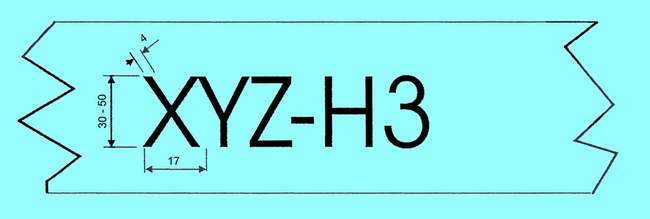
Drawing 1 Registration number
3.4.6 Registration of competitors and models
|
|
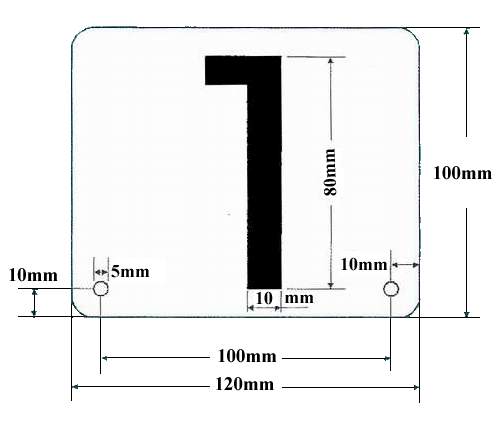
Drawing 2: Number plate for category FSR.
(5)
(6)
(7)
(8) In classes FSR-H and FSR-O the rescue of models is only performed after
completion of the heat. In FSR-O you are allowed to pickup your boat by
your self from within the pontoon and restart.
(9)
(10)
(11)
(12)
(13)
(14) FSR -V 35 boats must have a towing eye on the front for rescue purposes.
(15)
|
|
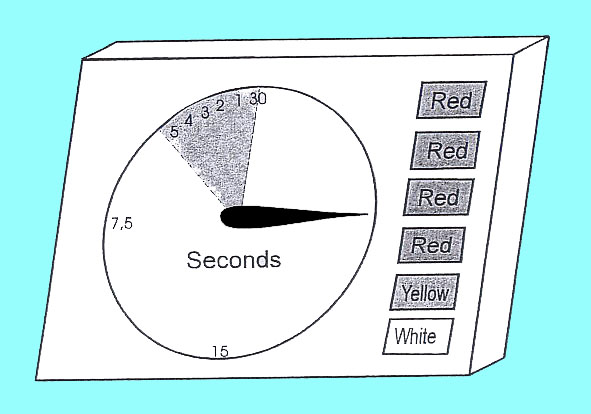
Drawing 5: Start clock for FSR-O races.
|
|
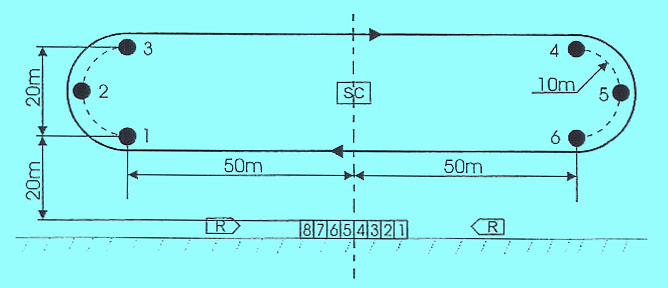
--------- = Start and finish line
8……1 = Start positions
RB = Rescue boat
SC = Start clock
Drawing 4: FSR - O competition course
(2) Starting time for the heat has to be shown on a start clock
(see drawing 5) or other adequate (optical or acoustic) means
(see 6.10 for start clock).
6.17 Procedures for races in the FSR-O classes
(1) A heat must have a minimum of 4 and maximum of 8 competitiors.
Each competitors must run at least 4 heats. If there are more
than 8 competitors entered in a class, a final must be run in
accordance with paragraph (3).
(2) A heat shall be so composed that the competitors will be mixed
in the heats as much as possible. Also the place on the pontoon
shall be randomly.
(3) 8 competitors with the highest scores from the heats qualify for
the final. For the final on heat is to be run. The best placed
competitor will occupy start position 1, the second best placed
start position 2, the third best placed start position 3, the
fourth best placed start position 4 etc. until the eight placed,
who will occupy start position 8.
(4) Before the start of each heat a radio check has to be carried out
to prevent interference. Therefore all transmitters and receivers
must be switched on. When it has been confirmed that there is no
radio interference it is no longer possible to protest.
(5) Each race consists of three independent phases:
- Preparation thim (Pit time) 2 minutes
- Control time (Milling time) 30 seconds
- Course time (Race time) 8 minutes for qualification and
12 minutes for final
(6) During preparation time engines are started, and the boats launched.
Races cannot be repeated. Preparation time must not be delayed or
cancelled, unless in exceptional circumstances at the judges
discretion (e.g. problems on the racecourse). Models can be adjusted
during the preparation time, however the competitor is not allowed
to leave the start position.
(7) During the control time no further boats can be launched. During the
course time the competitiors are allowed for after start.
(8) The competitors must drive their boats around the course or the
special lay-by zone allocated by the competition management, so that
all the competitors can cross the start line at the end of control
time. Boats must drive the course in the clockwise direction.
(9) During the last 15 seconds of the control time in order to ensure
the safety of all the boats, the models must keep in a straight line
after passing buoy No. 5. Zigzagging across the course,course changes
in excess of 45 degrees in order to avoid crossing the start line early
etc., are not allowed and are penalised with a one lap off.
(10) The end of the control time indicates the start of the race time,
regardless of where the boats are on the course.
(11) Models crossing the start line immediately before the end of control
time have a false start and must therefore complete an extra lap.
(12) The race officially starts, when at the end of control time the first
boat crosses the starting line.
(13) FSR-O boats can be repaired and/or refuelled during a heat. Only laps
completed during the heat will be counted.
(14) During the racetime you may leave the start position to pickup the model
or to fetch spare materials. However while driving the competitor must
not leave the start position. It is not allowed to remove the transmitter
from the start position.
(15) All buoys must be negotiated in accordance with the course. Touching the
buoys is allowed.Only those laps negotiated in accordance with the course
are counted.
(16) During the race each competitors laps must be displayed on a scoreboard.
(17) If a buoy is passed on the wrong side, it is allowed to re circle the
buoy without interfering with other competitors. If you do not re circle
the buoy the lap will not be counted.
(18) A slower boat can be overtaken on either side. During the overtaking
manoeuvre the slower boat must not change course or get in the way of
the overtaking boat. The overtaking boat can return to the racing line
when no less then three boat lengths ahead.
(19) The faster boat is not allowed to interfere with the slower model during
the overtaking manoeuvre.
(20) The boat on the race line, which is less than 5 boat lengths from a buoy,
has right of way. A manoeuvre to force a boat to pass on the inside of a
buoy in order to overtake is not permitted.
(21) If a boat looses the numberplate during the race it is allowed to complete
the commenced lap.Any laps completed after this lap without a number plat
will not be counted.
(22) A race can be stopped by the start position official due to exceptional
circumstances (e.g. sheered off buoys). Rules for stopping a race:
a) The start position official gives an acoustic signal about the same
as at the end of a race.At the same time as the signal is given the
clock which measures the duration of the race is stopped. After the
start position official has given the signal, the models have to
complete the commenced lap and this lap will be counted.
b) The time, from when the signal was given, until the models pass the
finish line, must be recorded. The models have to be taken from the
water and the engines stopped.
c) Competitors and assistants have to step back from the models.
Repairs are not permitted.During the interruption in the race models
can be rescued.
d) Rescued boats are not allowed to restart.
e) After resolving the cause for the interruption, the start position
official will give a start signal. The time keeping will continue
with the start signal.
f) If the race is stopped within the first three minutes it will be
annulled and restarted from the beginning.
(23) If a heat had to be stopped, all the laps and times have to be added together.
(24) In cases of unfair behaviour, interference with other competitors, not
following the rules or endangering spectators (e.g. collision with the
starting pontoon) the start position leader can pronounce the following
penalties.
a) The first occurrence of not following the rules described in
paragraphs (18) - (20), where no other boat has stopped as a result
of the incident a warning (yellow card) will be given.
b) The second occurrence of not following the rules described in
paragraph (18) - (20), or a more serious incident, or running over
a stopped boat will be punished with a one-lap deduction (yellow
card with number 1).
c) The third occurrence of not following the rules described in
paragraph (18) - (20), or exceptionally serious incident, or
causing another boat to stop will be punished by a twolap
deduction (yellow card with the number 2).
d) The fourth occurrence of not following the rules described in
paragraph (18) - (20), or exceptionally inconsiderate behaviour
of a competitor will be punished by disqualification (red card).
The model has to be taken out of the water immediately.
The competitor must be verbally and visually notified of a penalty.
There is no possibility of an appeal against the decision. The start
position official must record the penalty and the start number of
the competitor.
(25) The end of the race is indicated by an acoustic signal. All models
must after the signal complete the commenced lap and this lap will be
counted. After the final signal the lap counters will record the time
of delay for every model passing the finishing line. This time will
be recorded with the number of laps.
|